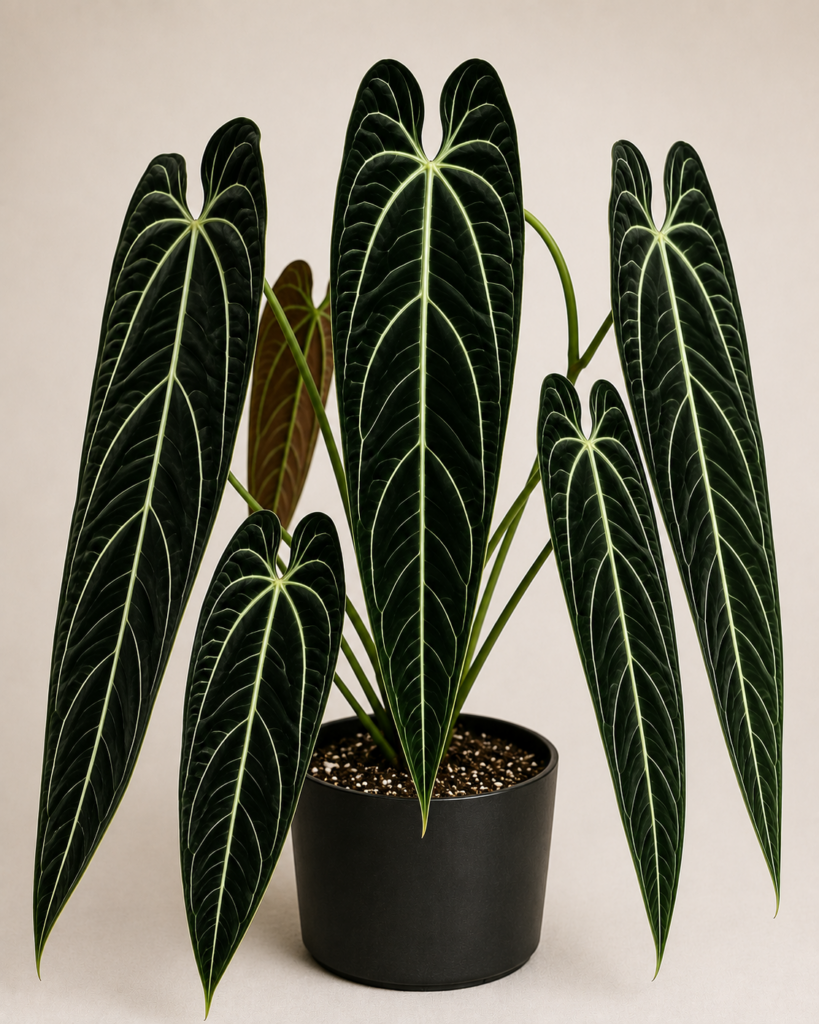
Anthurium warocqueanum T. Moore
Scientific Name
Accepted Name: Anthurium warocqueanum T. Moore
Author: Thomas Moore
First Published: The Florist and Pomologist, page 101 (1878)
Family: Araceae
Genus: Anthurium
Section: Cardiolonchium
Overview
Anthurium warocqueanum, widely known as the Queen Anthurium, is considered one of the most spectacular velvet-leaved species within the genus Anthurium. Its exceptionally long, elegant leaves, velvety texture, and striking pale venation have fascinated botanists, collectors, and horticulturists since its introduction to Europe in the nineteenth century.
Native to the humid tropical rainforests of Colombia, the species grows primarily as an epiphytic subshrub beneath the forest canopy, where high humidity, stable temperatures, and excellent air circulation create ideal growing conditions.
Beyond its extraordinary ornamental beauty, Anthurium warocqueanum occupies an important place in botanical history. Collected by Gustav Wallis during his Colombian expeditions and introduced to Europe through James Veitch & Sons, it quickly became one of the most admired ornamental Anthuriums of the Victorian era.
Today, it remains one of the defining species of Anthurium section Cardiolonchium.
Quick Facts
Native Range: Colombia
Distribution: Humid tropical rainforests of Colombia
Growth Habit: Epiphytic subshrub
Leaf Type: Long, velvety, pendant leaves
Distinctive Features
- Extremely long velvet leaves
- Prominent pale venation
- Elegant pendant growth
- One of the world’s most famous velvet Anthuriums
- Historic introduction through James Veitch & Sons
Variegata.Vienna Rating
🌍 Rarity: ★★★★☆
💎 Collector Value: ★★★★★
🎨 Ornamental Value: ★★★★★
🌿 Cultivation Difficulty: ★★★★☆
🌱 Beginner Friendly: ★★☆☆☆
📈 Growth Rate: ★★★☆☆
History
The story of Anthurium warocqueanum begins in the tropical rainforests of Colombia during the great botanical expeditions of the nineteenth century.
The species was collected by the renowned German plant collector Gustav Wallis, who at that time worked for the celebrated British horticultural company James Veitch & Sons. Living plants were transported to England, where they were cultivated and carefully studied.
In 1878, Thomas Moore formally described the species in The Florist and Pomologist. He dedicated the new Anthurium to the Belgian industrialist and distinguished plant collector Arthur Warocqué (1835–1880), whose extensive glasshouse collections at Mariemont ranked among the finest private plant collections in Europe.
Historical publications from 1878 included detailed botanical descriptions together with remarkable illustrations of the entire plant and its characteristic foliage. These publications also compared the species directly with Anthurium veitchii, highlighting their similar growth habit but distinctly different leaf morphology.
Shortly after its introduction, Anthurium warocqueanum received a Certificate of Merit from both the Royal Horticultural Society and the Royal Botanic Society, reflecting the extraordinary admiration it inspired within Victorian horticulture.
More than 145 years after its scientific description, Anthurium warocqueanum remains one of the most iconic species of the genus.
Habitat
Anthurium warocqueanum is endemic to the humid tropical rainforests of Colombia.
Its natural habitat is characterised by:
- High humidity throughout the year
- Warm, stable temperatures
- Bright filtered light beneath the forest canopy
- Excellent air movement
- Epiphytic growth on mature trees
- Organic debris surrounding the root system
Cultivation
☀️ Light
In nature, Anthurium warocqueanum grows beneath the forest canopy, receiving bright but filtered light.
Recommended Conditions
- Bright indirect light
- Avoid prolonged direct midday sun
- Gentle morning or evening sunlight is generally tolerated
- High-quality LED grow lights can provide excellent results
💧 Humidity
The species naturally grows under consistently humid tropical conditions.
High humidity combined with good air circulation promotes healthy foliage development.
🌱 Substrate
As an epiphytic species, Anthurium warocqueanum performs best in coarse, highly aerated substrates.
Suitable components include:
- Pine bark
- Perlite or pumice
- Coconut chips
- Small amounts of organic material
Excellent drainage is essential.
💦 Watering
The substrate should remain evenly moist without becoming waterlogged.
Consistent moisture combined with good aeration closely resembles the natural growing conditions of the species.
🌡 Temperature
The species originates from tropical forests with relatively stable temperatures throughout the year.
Culture is recommended above 18 °C (64 °F), while prolonged exposure to low temperatures should be avoided.
Growth Habit
Anthurium warocqueanum develops progressively longer pendant leaves as it matures.
Its velvety leaf surface and striking pale venation represent two of the defining characteristics of the species and have been highlighted since the earliest botanical publications.
The ecological significance of the exceptionally long leaves, velvety texture, and pronounced venation has not yet been fully clarified and remains an interesting subject for future scientific research.
Taxonomy
Family: Araceae
Genus: Anthurium
Section: Cardiolonchium
Species: Anthurium warocqueanum T. Moore
Scientifically Supported Information
The information presented in this article is supported by multiple independent botanical sources, including:
- Original description by Thomas Moore (1878)
- The Florist and Pomologist (1878)
- Royal Botanic Gardens, Kew – Plants of the World Online (POWO)
- Modern taxonomic literature on the genus Anthurium
- Historical horticultural literature of the nineteenth century
References
- Moore, T. (1878). The Florist and Pomologist, page 101.
- Royal Botanic Gardens, Kew – Plants of the World Online (POWO).
- Historical issues of The Florist and Pomologist.
- Additional botanical and historical literature.
Scientific Notes
The information presented in this article is based on the current state of botanical knowledge, historical primary sources and recognised taxonomic literature.
Where scientific studies are currently unavailable—particularly regarding specific cultivation parameters such as Lux, PPFD, Daily Light Integral (DLI) or detailed physiological characteristics—no unsupported numerical recommendations have been included.
Variegata.Vienna deliberately distinguishes between scientifically supported information, historical documentation, cultivation recommendations and open research questions. This article will be continuously reviewed and expanded as new scientific publications and verified historical sources become available.