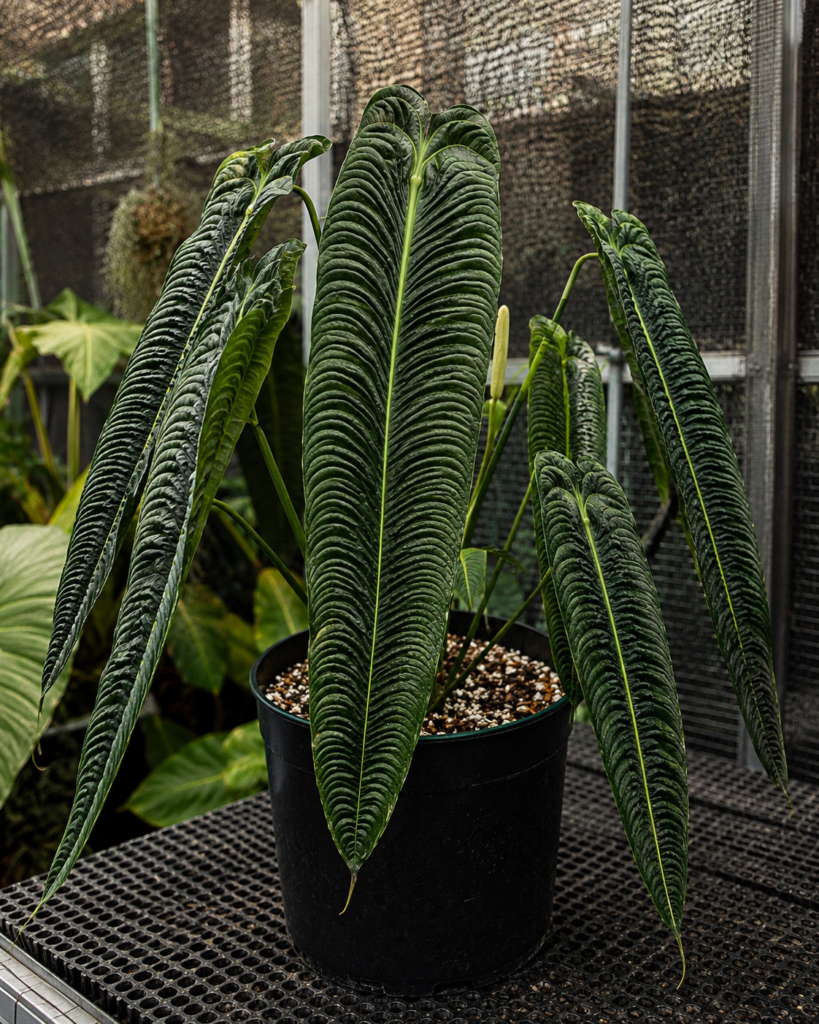
Anthurium veitchii Mast.
Scientific Name
Accepted Name: Anthurium veitchii Mast.
Author: Maxwell Tylden Masters
First Published: The Gardeners’ Chronicle, New Series (1876)
Family: Araceae
Genus: Anthurium
Section: Cardiolonchium
Overview
Anthurium veitchii, widely known as the King Anthurium, is one of the most iconic foliage species within the genus Anthurium. Its exceptionally long, elegantly pendent leaves and deeply corrugated surface distinguish it from virtually every other species in cultivation.
Native to the humid tropical rainforests of Colombia, Anthurium veitchii grows primarily as an epiphytic subshrub attached to trees, where it benefits from high humidity, constant air movement, and bright filtered light beneath the forest canopy.
Beyond its remarkable ornamental appearance, the species occupies an important place in botanical history. Introduced to Europe during the great plant-hunting expeditions of the nineteenth century, it represents one of the earliest and most celebrated Anthuriums cultivated by the famous British nursery James Veitch & Sons.
Today, Anthurium veitchii remains one of the most admired species among collectors and botanical gardens worldwide.
Quick Facts
Native Range: Colombia
Distribution: Chocó and Antioquia
Growth Habit: Epiphytic subshrub
Leaf Type: Long, pendant, deeply corrugated leaves
Distinctive Features
- Exceptionally long pendant foliage
- Deeply corrugated leaf surface
- Glossy dark green leaves
- One of the most recognisable Anthurium species
- Historically introduced through James Veitch & Sons
Variegata.Vienna Rating
🌍 Rarity: ★★★☆☆
💎 Collector Value: ★★★★★
🎨 Ornamental Value: ★★★★★
🌿 Cultivation Difficulty: ★★★☆☆
🌱 Beginner Friendly: ★★★☆☆
📈 Growth Rate: ★★★☆☆
History
The story of Anthurium veitchii begins in the tropical rainforests of Colombia during one of the great botanical exploration periods of the nineteenth century.
The species was collected by the renowned German plant collector Gustav Wallis, who at the time worked for the famous British horticultural company James Veitch & Sons. During his expeditions through Colombia, Wallis discovered numerous remarkable tropical plants, including Anthurium veitchii, which was subsequently shipped alive to England.
The species was formally described by Maxwell Tylden Masters in 1876 and published in The Gardeners’ Chronicle, one of the leading horticultural journals of its time.
The specific epithet veitchii was chosen in honour of the Veitch family and their nursery, recognising their extraordinary contribution to the introduction of tropical plants into European horticulture.
Historical publications from The Gardeners’ Chronicle (1876) and The Florist and Pomologist (1878) illustrate the remarkable enthusiasm surrounding this spectacular new Anthurium. Both publications featured detailed descriptions and illustrations, demonstrating that the species quickly became one of the most admired ornamental foliage plants of the Victorian era.
More than a century later, Anthurium veitchii continues to justify its reputation as one of the world’s finest ornamental Anthuriums.
Habitat
Anthurium veitchii is endemic to Colombia, where it inhabits humid tropical rainforests within the departments of Chocó and Antioquia.
Its natural habitat is characterised by:
- High year-round humidity
- Warm, stable temperatures
- Bright filtered light beneath the forest canopy
- Excellent air circulation
- Epiphytic growth on mature trees
- Organic debris accumulating around roots
Cultivation
☀️ Light
In nature, Anthurium veitchii grows attached to trees beneath the forest canopy, receiving bright but filtered light throughout the day.
Recommended Conditions
- Bright indirect light
- Avoid prolonged direct midday sun
- Gentle morning or late afternoon sunlight is generally well tolerated
- High-quality LED grow lights provide excellent results
Scientific Status
No peer-reviewed habitat measurements for Lux, PPFD or Daily Light Integral (DLI) specific to Anthurium veitchii could be identified during the current literature review.
Current cultivation recommendations are therefore based on habitat ecology, botanical garden practice, and long-term horticultural experience rather than experimentally validated light measurements.
💧 Humidity
The species naturally grows under consistently humid tropical conditions.
Recommended Conditions
- High humidity is recommended.
- Good air circulation is essential.
- Avoid prolonged dry air.
At present, no scientifically validated minimum or optimal relative humidity values specific to Anthurium veitchii have been published.
🌱 Substrate
As an epiphytic species, Anthurium veitchii performs best in coarse, highly aerated substrates that retain moisture while allowing rapid drainage.
Suitable components include:
- Pine bark
- Perlite or pumice
- Orchid bark
- Small amounts of organic material
Compacted or permanently waterlogged substrates should be avoided.
💦 Watering
The substrate should remain evenly moist while allowing excess water to drain freely.
Recommended practice:
- Water thoroughly.
- Allow slight drying between waterings.
- Reduce watering during cooler periods.
- Avoid standing water around the roots.
These recommendations are based primarily on successful horticultural practice rather than experimental scientific studies.
🌡 Temperature
The species originates from tropical Colombian rainforests with relatively stable temperatures throughout the year.
Recommended Conditions
Ideal temperatures:
18–26 °C (64–79 °F)
Extended exposure to cold should be avoided.
Growth Habit
Anthurium veitchii grows as an epiphytic subshrub and develops progressively longer pendent leaves as it matures.
Its deeply corrugated foliage is one of the most distinctive characteristics of the species and has been highlighted in botanical literature since the earliest historical publications.
The ecological function of these pronounced leaf corrugations has not yet been fully clarified and remains an interesting subject for future research.
Taxonomy
Family: Araceae
Genus: Anthurium
Section: Cardiolonchium
Species: Anthurium veitchii Mast.
Scientifically Supported Information
The information presented in this article is supported by multiple independent botanical sources, including:
- Original description published in The Gardeners’ Chronicle (1876)
- Historical publication: The Florist and Pomologist (1878)
- Royal Botanic Gardens, Kew – Plants of the World Online (POWO)
- International Plant Names Index (IPNI)
- Modern taxonomic literature on the genus Anthurium
Where no peer-reviewed scientific data were available, this has been explicitly stated. Practical cultivation recommendations are clearly distinguished from scientifically validated information.
References
- Masters, M. T. (1876). The Gardeners’ Chronicle, New Series.
- The Gardeners’ Chronicle. (16 December 1876). New Garden Plants.
- The Florist and Pomologist. (July 1878).
- Royal Botanic Gardens, Kew – Plants of the World Online (POWO).
- International Plant Names Index (IPNI).
- Additional botanical and historical literature.
Editorial Note
This species profile is based on the current state of botanical knowledge, historical primary sources, and carefully documented cultivation experience.
Variegata.Vienna distinguishes between scientifically supported information, historical documentation, cultivation recommendations, and open research questions. Where scientific evidence is currently unavailable, this is stated transparently.
This article will be continuously reviewed and expanded as new botanical research and verified historical sources become available.