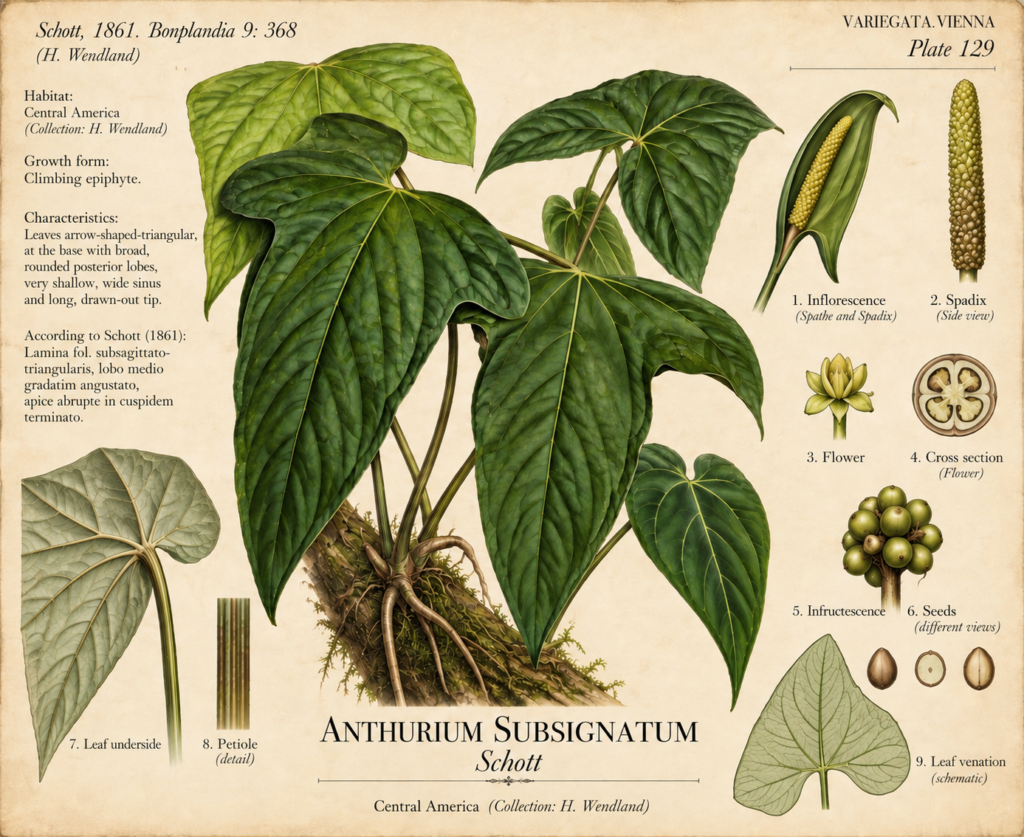
Anthurium subsignatum Schott
A rare Central American Anthurium with a remarkable nineteenth-century history
Anthurium subsignatum Schott is a relatively rarely documented Anthurium from Central America. The species was described by Heinrich Wilhelm Schott in 1861 and published in Bonplandia 9: 368.
Its history is closely connected with the Central American botanical expeditions of Hermann Wendland and with the development of Anthurium cultivation in nineteenth-century Europe.
Scientific Classification
Kingdom: Plantae
Order: Alismatales
Family: Araceae
Genus: Anthurium
Section: Semaeophyllium
Species: Anthurium subsignatum Schott
Author: Heinrich Wilhelm Schott
First published: 1861
Publication: Bonplandia 9: 368
Origin & Distribution
The original publication gives the locality simply as:
“Amer. central. (Wendland.)”
Schott therefore recorded the plant as originating from Central America and explicitly associated the material with Hermann Wendland.
Modern taxonomic treatments place the species in a range extending from southern Nicaragua to Costa Rica, with the most important documented populations occurring in Costa Rica.
A. subsignatum is an epiphytic climber associated with humid tropical forest environments. Modern treatments particularly associate it with tropical wet and premontane wet forests.
The species is generally encountered at relatively low elevations rather than in high montane habitats.
Historical Background
The story of Anthurium subsignatum begins with Hermann Wendland, whose botanical collecting activities in Central America supplied important living and herbarium material to European botanical institutions.
Schott introduced the species in 1861 with the following statement:
“Von Hermann Wendland eingeführt, erhielten wir ein Anthurium, das sich nunmehr als ausgezeichnete Art erweiset.”
In essence, Schott states that they had received an Anthurium introduced by Hermann Wendland which he now recognised as a distinct species.
The species is therefore a direct product of the nineteenth-century exchange of Central American plant material with European botanical collections.
Schott’s Original Description
Schott described A. subsignatum as a relatively slender plant with a somewhat upright stem and internodes approximately one to two inches long.
The petioles were described as straight and slightly grooved.
The leaf blade was characterised as:
“sub-sagittato-triangularis”
— approximately sagittate-triangular in outline.
The posterior lobes were described as broad, rounded and horizontally spreading, separated by a very shallow and widely open sinus. The central lobe gradually narrowed and terminated abruptly in a long pointed tip.
Schott recorded three veins in each posterior lobe and approximately six to seven stronger lateral veins on either side of the midrib.
The peduncle was shorter than the petiole.
The spathe was described as:
green, lanceolate, acuminate, reflexed and clasping at the base.
The spadix was described as:
yellow and shortly stipitate.
These details make the original protologue particularly valuable for understanding the morphology by which Schott distinguished the species.
Morphology
A. subsignatum is an epiphytic climbing Anthurium with a distinctive deeply lobed leaf architecture.
The leaves are broadly ovate-triangular and can become deeply divided towards the base. The lateral lobes spread outward, while the central lobe is elongated and gradually narrows towards its pointed apex.
The upper surface is dark green. The underside is considerably paler and can show a silvery-green appearance, a feature that is especially noticeable on mature leaves.
Modern descriptions record:
- long petioles,
- a distinct geniculum,
- deeply lobed blades,
- several basal and lateral veins,
- pale green spathes,
- yellow-green to bright yellow spadices.
Following flowering, the infructescence becomes pendent. Mature fruits can develop a violet-purple coloration, with a contrasting pale base.
Inflorescence
The inflorescence is held relatively erect.
The spathe is generally pale green, lanceolate and pointed. During development it may become reflexed.
The spadix is cylindrical to elongated and ranges from yellow-green to bright yellow.
After anthesis, the developing infructescence becomes pendent and the fruits mature towards violet-purple tones.
Taxonomic History
The taxonomic history of Anthurium subsignatum is particularly interesting.
Because of its strongly lobed foliage, the species has historically been confused with other Central American Anthuriums displaying a similar leaf architecture.
At one stage, A. subsignatum was included within the broader concept of Anthurium trilobum.
Modern taxonomic work has restored A. subsignatum as a distinct species.
It is currently placed in the section Semaeophyllium, a group containing several Central American Anthuriums with characteristic lobed foliage.
The species has also been discussed in relation to Anthurium garagaranum and other members of this complex. Historical synonymies should therefore always be interpreted in the context of the taxonomic treatment in which they were published.
Historical Cultivation in Europe
The history of A. subsignatum did not end with its scientific description.
The species entered European living collections during the nineteenth century, at a time when Anthuriums were becoming increasingly important plants of warm glasshouse cultivation.
An especially valuable Austrian record dates from 1884.
In the Wiener Illustrirte Garten-Zeitung, a report on a flower exhibition in Graz lists Anthurium subsignatum among a group of new and rare, predominantly flowering Anthuriums.
The report mentions Scherzerianum, Andraeanum, Ferrierense, Palmeri, Decardii, “subsignatum”, argenteo-marmoratum and others in connection with flowering exhibition plants.
This provides contemporary evidence that A. subsignatum was being cultivated and displayed as a flowering plant in an Austrian collection by 1884.
Importantly, the historical source concerns an exhibition in Graz. It therefore should not be interpreted as proof that the particular plant was cultivated in Vienna itself.
A Plant of Historical Horticultural Interest
The 1884 record places A. subsignatum within the rapidly developing European Anthurium culture of the late nineteenth century.
During this period, collectors and growers were not only maintaining botanical species but also experimenting extensively with hybridisation.
This makes A. subsignatum particularly interesting from a horticultural-historical perspective: it was already being maintained as a living and flowering plant only a few decades after its scientific description.
Historical Hybrids
A. subsignatum also became involved in nineteenth-century Anthurium breeding.
Anthurium× Chantrieri
Recorded as a hybrid between:
Anthurium subsignatum × Anthurium ornatum
The hybrid was associated with Édouard André and the horticultural work of the Chantrier brothers.
Jules Rudolph described the plant in 1898 as having dark, glossy green foliage, triangular to rhomboid-acuminate leaves, an ivory-white erect spathe and a dark violet spadix.
Anthurium× Eduardi
Another historical hybrid was recorded as:
Anthurium crystallinum × Anthurium subsignatum
These historical hybrids demonstrate that A. subsignatum was considered useful not merely as a botanical curiosity but also as a potential breeding parent.
Natural Habitat
In cultivation, it is useful to remember that A. subsignatum is fundamentally an epiphytic tropical forest plant.
Its natural environment provides several clues for successful cultivation:
- high atmospheric humidity,
- warm temperatures,
- filtered or broken light,
- excellent air movement,
- constant but well-aerated root-zone moisture,
- organic material accumulating around the epiphytic root system,
- and access to climbing surfaces.
The plant should therefore not be treated like a terrestrial Anthurium growing in dense, permanently wet soil.
Variegata.Vienna Recommendation
Cultivation & Care
Difficulty: Intermediate
A. subsignatum is best treated as a warm-growing, humidity-loving epiphytic Anthurium. It can become a rewarding specimen when allowed to climb and develop mature foliage.
Light
Bright, filtered light is recommended.
The plant should receive plenty of light without prolonged exposure to harsh midday or direct summer sun.
A bright position close to a suitable artificial grow light can work very well in cultivation.
Temperature
Ideal daytime temperature: approximately 22–28 °C
Ideal nighttime temperature: approximately 18–22 °C
Consistently warm conditions are preferable. Prolonged cold periods should be avoided.
Humidity
We recommend approximately 70–85 % relative humidity for vigorous growth.
Higher humidity can be beneficial, particularly when combined with good air circulation.
Constantly stagnant, saturated air should nevertheless be avoided.
Substrate
A very airy, fast-draining epiphytic substrate is recommended.
A suitable structure can include:
- orchid bark,
- coarse perlite or pumice,
- sphagnum or another moisture-retaining component,
- and a small amount of organic material.
The objective is a substrate that retains some moisture while remaining highly oxygenated around the roots.
Watering
Keep the root zone evenly but not permanently saturated.
Allow the upper part of the substrate to begin drying before watering again, while avoiding prolonged complete desiccation of the root system.
Good drainage is essential.
Fertilisation
During active growth, a dilute, balanced fertiliser can be applied regularly.
We recommend avoiding excessive fertiliser concentration, particularly in small containers or under low-light conditions.
A consistent, gentle feeding regime is preferable to occasional heavy fertilisation.
Climbing
A climbing support is strongly recommended.
Because A. subsignatum is an epiphytic climber, a moss pole, bark support or another textured climbing structure can encourage more natural development.
Allowing the plant to climb can also help it develop larger and more mature foliage.
Air circulation
Good air movement is important, particularly under high-humidity conditions.
Gentle continuous circulation is preferable to strong direct airflow.
Variegata.Vienna Assessment
Botanical rarity: ★★★★☆
Historical interest: ★★★★★
Cultivation difficulty: ★★★☆☆
Collector interest: ★★★★☆
A. subsignatum is not necessarily one of the most commonly encountered Anthuriums in modern collections, but its combination of distinctive morphology, nineteenth-century history and documented use in historical hybridisationmakes it especially interesting for collectors and botanical enthusiasts.
For Variegata.Vienna, its historical connection to Hermann Wendland, Heinrich Wilhelm Schott and nineteenth-century Austrian horticulture is one of the most compelling aspects of the species.
Nomenclature
Accepted name: Anthurium subsignatum Schott
Family: Araceae
Genus: Anthurium
Section: Semaeophyllium
Author: H. W. Schott
Year of publication: 1861
Original publication: Bonplandia 9: 368
Original locality:
“Amer. central. (Wendland.)”
The year 1860, sometimes encountered in secondary sources, is not the correct publication year of Schott’s protologue. The original description appeared in 1861.
Historical Sources & Literature
Schott, H. W. (1861).
Anthurium subsignatum. Bonplandia 9: 368.
Rudolph, J. (1898).
Caladium, Anthurium, Alocasia et autres Aroïdées de serre. Paris.
Linsbauer, K. (1907).
Über Wachstum und Geotropismus der Aroideen-Luftwurzeln. Flora 97: 267–298.
Wiener Illustrirte Garten-Zeitung (1884).
“Blumen-Ausstellung in Graz”, June 1884, p. 217.
Wendland, H. — Central American collections.
Historical collecting material and subsequent nomenclatural documentation.
Royal Botanic Gardens, Kew.
Plants of the World Online — Anthurium subsignatum Schott.
Variegata.Vienna Encyclopedia
Anthurium subsignatum Schott
Araceae · Semaeophyllium
First described: 1861
Origin: Central America
Current distribution: Southern Nicaragua – Costa Rica
Growth form: Epiphytic climber
Variegata.Vienna
Encyclopedia of Aroids · Botanical Research · Historical Documentation
Research, cultivation knowledge and historical sources are presented separately where appropriate. Historical statements are based on contemporary botanical and horticultural literature; cultivation recommendations represent the practical assessment of Variegata.Vienna.
© Variegata.Vienna — Botanical knowledge preserved for the future. 🌿📚