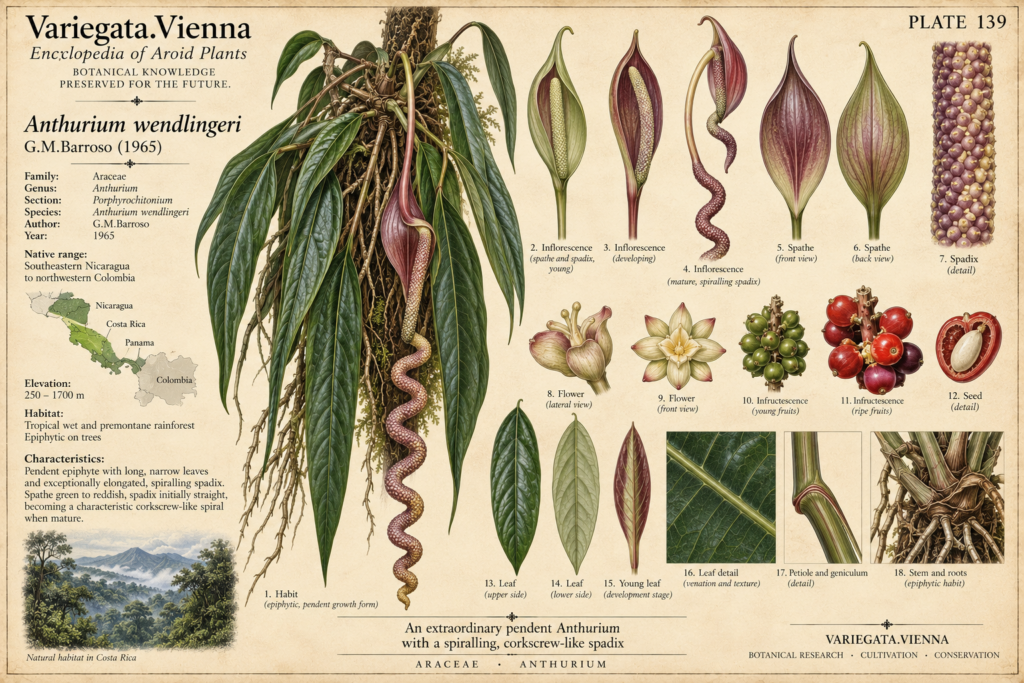
Anthurium wendlingeriG.M.Barroso
A remarkable pendent Anthurium with a spiralling, corkscrew-like spadix
Anthurium wendlingeri is one of the most distinctive pendent Anthuriums of Central America. Unlike many of the large, upright or climbing species cultivated by collectors, it develops as a pendent epiphyte, producing long, narrow leaves and remarkably elongated inflorescences.
Its most spectacular feature is the spadix. Initially relatively straight, it gradually develops a pronounced spiral as it matures, eventually forming the characteristic corkscrew-like structure for which the species is so well known.
Described by Graziela M. Barroso in 1965 from Costa Rica, Anthurium wendlingeri is now recognised across a broad natural range extending from southeastern Nicaragua through Costa Rica and Panama to northwestern Colombia.
Scientific Classification
| Character | Classification |
|---|---|
| Scientific name | Anthurium wendlingeri G.M.Barroso |
| Family | Araceae |
| Genus | Anthurium Schott |
| Section | Porphyrochitonium |
| Growth form | Pendent epiphytic subshrub |
| Native range | Southeastern Nicaragua to northwestern Colombia |
| Habitat | Tropical wet and premontane rainforest |
| First published | 1965 |
| Author | Graziela M. Barroso |
Origin & Distribution
Anthurium wendlingeri has a relatively broad distribution in Central America and northwestern South America.
Its known natural range extends from southeastern Nicaragua through Costa Rica and Panama to northwestern Colombia.
The species occurs across a considerable elevational range, from lower-elevation wet forests to premontane environments. Modern collections document it from approximately 250 to 1700 metres above sea level.
Throughout its range, A. wendlingeri is associated with humid tropical forest environments and grows primarily as an epiphyte on trees.
The Discovery of Anthurium wendlingeri
The history of Anthurium wendlingeri begins in Costa Rica.
Graziela M. Barroso described the species in 1965 from material collected in the province of Cartago near Turrialba, at approximately 700 metres elevation.
The type locality was recorded as Pavones, Turrialba, although the original publication contains the locality name “Turones”. Later botanical work clarified the locality as Pavones.
The type material was collected by Wendlinger, whose name is commemorated in the specific epithet wendlingeri.
The original description was based on living material, an important detail when considering the unusual morphology and colour changes associated with the species.
Original Description
The species was originally published by Graziela M. Barroso in:
“Especie nueva de Anthurium (Araceae) originaria de Costa Rica”
Boletín de la Sociedad Venezolana de Ciencias Naturales 26: 151–152, 1965.
The original publication included an illustration of the newly described species.
Barroso characterised A. wendlingeri as an epiphytic Anthurium with a distinctive pendent habit, long and narrow foliage and an unusually elongated inflorescence.
One particularly notable detail of the original description is the colour assigned to the spadix, which Barroso described as dark purple.
Later observations revealed considerably more variation in spadix colour and development, contributing to the subsequent taxonomic study of the species.
Growth Form
Anthurium wendlingeri is a pendent epiphyte with a relatively short stem and short internodes.
The stems may reach approximately 20 cm in length, while the internodes are generally around 1.5–2 cm.
The plant produces strong roots adapted to its epiphytic existence.
The older cataphylls dry brown and gradually break down into coarse, longitudinal fibres that remain around the stem.
As the plant matures, its long leaves and inflorescences extend outward and downward, producing the characteristic hanging architecture of the species.
Leaves
The leaves are exceptionally long in relation to their width.
Mature blades may reach approximately:
32–80 cm long × 3–11 cm wide.
They are elongated and oblong, with an acuminate apex and a rounded to truncate base.
The upper surface is dark green and may appear slightly velvety, with scattered glandular punctation. The lower surface is generally paler and more semi-glossy.
The primary lateral veins are numerous and clearly developed, with approximately 11–24 primary veins on each side of the midrib.
This combination of long, narrow blades and pendent growth gives A. wendlingeri an appearance that is immediately different from the broad, cordate foliage of many familiar Anthuriums.
The Inflorescence
The inflorescences are pendent to spreading and arise on relatively long peduncles.
The peduncle may reach approximately 13–42 cm in length.
The spathe is comparatively narrow, generally around 7–11 cm long and 0.8–1.3 cm wide.
It is typically green when developing and may develop reddish or purplish tones during maturity.
After anthesis, the spathe gradually withers and may curl away from the developing spadix.
The Corkscrew Spadix
The most spectacular feature of Anthurium wendlingeri
The spadix is the defining feature of Anthurium wendlingeri.
When young, it is relatively straight.
As it develops, however, the structure begins to curve progressively until it forms a pronounced spiral.
In a mature specimen, the spadix can resemble a long botanical corkscrew, sometimes reaching approximately 80 cm in length.
This extraordinary shape is not an abnormality.
It represents a characteristic stage in the development of the typical form of A. wendlingeri.
The spiral also changes the visual appearance of the inflorescence considerably as it matures. A young flowering plant may therefore look quite different from the same plant several weeks later, once the spadix has developed its characteristic coils.
Flowers
The individual flowers are small and arranged along the exceptionally elongated spadix.
The flowers are four-lobed, with relatively inconspicuous tepals and finely papillose surfaces.
Flowering progresses along the spadix, producing the characteristic spiral arrangement of visible flowers.
The unusual length and later coiling of the spadix make the reproductive structure of A. wendlingeri one of the most distinctive within its section.
Fruits & Seeds
Following anthesis, A. wendlingeri produces a pendent infructescence.
The berries are approximately 5 mm long and generally reddish, ranging from globose to somewhat oblong in shape.
The apex is flattened and bears a small central depression.
Each berry normally contains several seeds, most commonly around four.
The combination of the pendent infructescence and red fruits continues the characteristic downward-growing architecture of the plant even after flowering has finished.
Taxonomic History
The taxonomy of Anthurium wendlingeri has become increasingly interesting as additional populations have been studied.
The original description was based on material from Costa Rica, but later collections demonstrated considerable geographical and morphological variation throughout Central America.
Differences have been observed in:
- leaf shape and proportions,
- surface texture,
- spathe colour,
- spadix colour,
- and particularly the behaviour of the spadix during anthesis and maturation.
These differences eventually led to the recognition of a distinct infraspecific taxon.
Anthurium wendlingerivar. horichii
In 2022, Anthurium wendlingeri var. horichii was described by Thomas B. Croat.
The variety is known from Costa Rica, particularly from the Caribbean slope of the Talamanca region, where it occurs in wet tropical and premontane forests.
It shares the characteristic pendent epiphytic habit of A. wendlingeri, but differs in several morphological features.
One of the most striking differences concerns the spadix.
Whereas the typical form develops the characteristic spiral or coiled spadix, var. horichii has been characterised by a straight spadix at anthesis.
The distinction is therefore not merely a matter of colour or geographical origin, but involves a fundamental feature of the reproductive morphology.
Anthurium kubickiiand its Relationship to var. horichii
The taxonomic history becomes even more interesting with the name Anthurium kubickii.
This taxon was described separately in the same period, based on plants showing a combination of characters similar to those found in A. wendlingeri.
Further comparison demonstrated that A. kubickii and A. wendlingeri var. horichii represent the same taxonomic entity.
In the 2024 revision of the pendent Porphyrochitonium species of Costa Rica and Panama, Anthurium kubickii is therefore treated as a synonym of A. wendlingeri var. horichii.
This is an excellent example of how taxonomic names can change as additional living plants and historical material are compared.
Spiral or Straight?
The distinction between the two currently recognised forms is particularly fascinating.
Typical A. wendlingeri
The typical form is characterised by its:
- pendent epiphytic habit,
- long and narrow leaves,
- elongated inflorescences,
- and especially its coiled or spiralling spadix.
A. wendlingerivar. horichii
The variety differs in several characters, including:
- its more restricted distribution,
- morphological differences in the leaves and petioles,
- reddish spathes,
- and a straight spadix at anthesis.
The 2024 revision uses the spadix form as one of the most useful characters for distinguishing the two.
At the same time, the authors emphasise that considerable morphological variation remains throughout the wider distribution of the species.
Natural Habitat
In its natural environment, Anthurium wendlingeri grows in humid tropical and premontane forests.
As an epiphyte, it establishes itself on trees rather than rooting directly into the forest soil.
Its pendent architecture allows the long leaves and inflorescences to hang freely from branches and trunks.
The species occurs across a substantial elevation range, and environmental conditions therefore vary considerably between populations.
Flowering and fruiting have been documented throughout the year, rather than being restricted to a single short flowering season.
Conservation
The conservation status of A. wendlingeri needs to be considered together with its infraspecific diversity.
The typical form has a broad geographic distribution extending across several countries and is currently considered to have a comparatively secure conservation position.
The situation is different for var. horichii, which has a much more restricted distribution in Costa Rica.
Its known habitat is affected by agricultural development, including large-scale cultivation in surrounding lowland areas.
The 2024 assessment therefore treats A. wendlingeri var. horichii as Critically Endangered, while the typical form has a considerably less threatened status.
This distinction demonstrates why conservation assessments can become much more meaningful when variation within a species is recognised rather than treating an entire species as ecologically uniform.
Cultivation & Care
A. wendlingeri is best cultivated according to its natural epiphytic habit.
Light
Bright, filtered light is ideal. Gentle morning sunlight can be beneficial, while strong midday exposure should be avoided.
Humidity
High atmospheric humidity is recommended, particularly when combined with good air circulation.
Substrate
The root system benefits from an open, airy substrate with excellent drainage. Bark, coarse mineral components and other epiphytic materials are preferable to dense, water-retentive soil.
Water
The roots should remain evenly hydrated but receive sufficient oxygen. Constant saturation should be avoided.
Temperature
Warm conditions during active growth are appropriate. A natural reduction in temperature during the night is well suited to the species, provided prolonged cold exposure is avoided.
Growth habit
The plant should be given enough space to hang freely.
A mature specimen should not be forced into an upright growing position. Its long leaves and spectacular inflorescences are best appreciated when allowed to develop naturally downward.
Variegata.Vienna Recommendation
Anthurium wendlingeri should be appreciated not simply as another collector Anthurium, but as a highly specialised epiphytic growth form.
An elevated position, hanging basket or other arrangement that allows the plant to grow downward is particularly suitable.
The most important consideration for a mature specimen is space.
The leaves can become remarkably long, while a flowering plant may eventually produce an inflorescence with a spadix approaching 80 cm.
When the characteristic spiral develops, the plant becomes one of the most visually unusual Anthuriums in cultivation.
Variegata.Vienna Assessment
| Category | Rating |
|---|---|
| Botanical rarity | ★★★★☆ |
| Historical interest | ★★★★☆ |
| Cultivation suitability | ★★★★☆ |
| Ornamental value | ★★★★★ |
| Collector interest | ★★★★★ |
| Botanical distinctiveness | ★★★★★ |
Variegata.Vienna assessment:
An exceptionally distinctive Anthurium combining an unusual pendent epiphytic habit with extremely elongated foliage and one of the most remarkable inflorescences found within the genus.
The transformation of the young, relatively straight spadix into a long, spiralling structure gives the mature plant a character that is almost unlike any other Anthurium.
Nomenclature
Accepted name:
Anthurium wendlingeri G.M.Barroso
Family:
Araceae
Genus:
Anthurium Schott
Section:
Porphyrochitonium
First published:
1965
Original publication:
Boletín de la Sociedad Venezolana de Ciencias Naturales 26: 151–152.
Infraspecific taxonomy
The modern treatment of the species includes the typical form and the recognised taxon:
Anthurium wendlingeri var. horichii Croat
The rank used for the typical taxon differs between current databases and the 2024 regional revision. Kew currently lists the typical taxon as A. wendlingeri subsp. wendlingeri, while Ortiz et al. (2024) use A. wendlingeri var. wendlingeri.
This difference in rank is retained here for transparency.
Synonym
Anthurium kubickii Croat
is treated by Ortiz et al. (2024) as a synonym of Anthurium wendlingeri var. horichii.
Historical & Scientific Sources
Barroso, G.M. (1965).
Especie nueva de Anthurium (Araceae) originaria de Costa Rica.
Boletín de la Sociedad Venezolana de Ciencias Naturales 26: 151–152.
Croat, T.B. (1983).
A Revision of the Genus Anthurium (Araceae) of Mexico and Central America.
Annals of the Missouri Botanical Garden 70.
Croat, T.B. et al. (2022).
The current status of Anthurium sect. Porphyrochitonium (Araceae) and allies, with many new species from Central and South America.
Aroideana 45.
Ortiz, O.O., Cedeño-Fonseca, M., Jiménez, J.E. & Hughes, J.M. (2024).
The pendent species of Anthurium sect. Porphyrochitonium from Costa Rica and Panama: synopsis, nomenclatural notes, new species, and conservation status.
Webbia 79(2): 311–350.
Royal Botanic Gardens, Kew.
Plants of the World Online: Anthurium wendlingeri G.M.Barroso.
Variegata.Vienna Encyclopedia
Anthurium wendlingeri is one of the most remarkable pendent Anthuriums of Central America.
Described by Graziela M. Barroso in 1965 from Costa Rica, it grows as an epiphyte in humid tropical forests extending from Nicaragua to Colombia.
Its long, narrow leaves give the mature plant an unmistakable hanging architecture. But it is the inflorescence that truly sets the species apart.
A young spadix begins relatively straight. As it develops, it gradually bends and eventually forms a long, spiralling corkscrew-like structure, sometimes approaching 80 cm in length.
Modern taxonomic research has also revealed that the species is more variable than its original description might suggest. The recognition of var. horichii, together with the later synonymisation of A. kubickii, illustrates how our understanding of this remarkable group continues to develop.
For Variegata.Vienna, Anthurium wendlingeri represents something particularly valuable: a species whose extraordinary appearance is matched by an equally fascinating botanical history.
Variegata.Vienna — Botanical knowledge preserved for the future. 🌿❤️