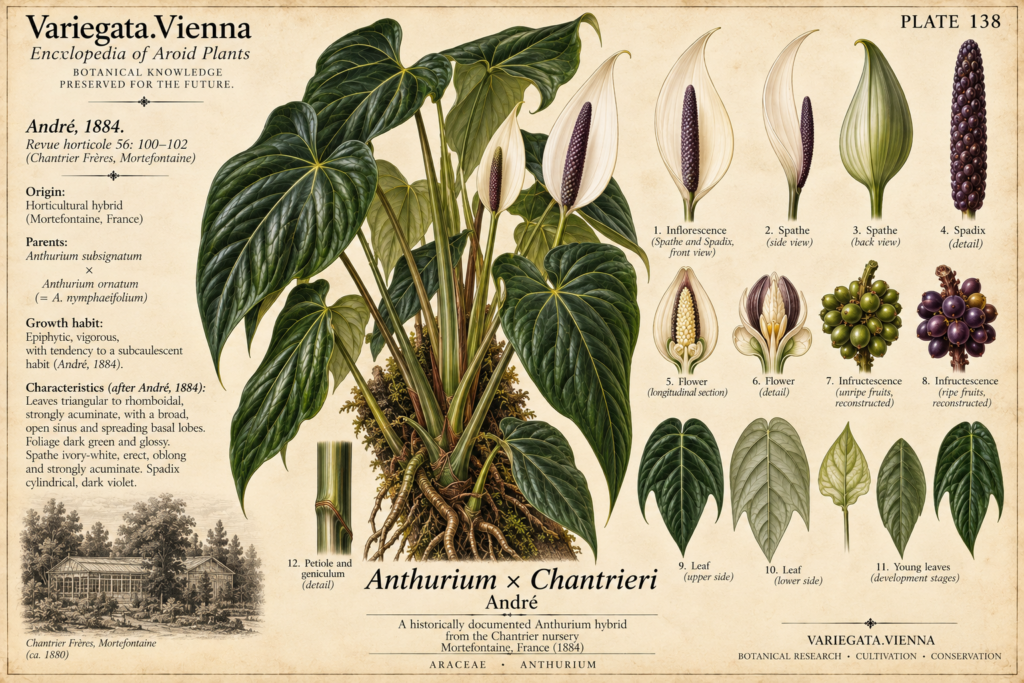
Anthurium × ChantrieriAndré
A historically documented Anthurium hybrid from the Chantrier nursery
Anthurium × Chantrieri is a historically documented nineteenth-century Anthurium hybrid associated with the horticultural work of the Chantrier brothers at Mortefontaine, France. The hybrid was described by Édouard André in 1884 and was recorded as the result of crossing Anthurium subsignatum with Anthurium ornatum.
Its historical importance lies not only in the plant itself, but in the unusually clear documentation surrounding its origin. André’s 1884 account, contemporary horticultural reports, and the later work of Jules Rudolph together preserve a detailed record of its parentage, appearance and place within the developing culture of Anthurium hybridisation.
Scientific Classification
Kingdom: Plantae
Order: Alismatales
Family: Araceae
Genus: Anthurium
Rank: Hybrid
Name: Anthurium × Chantrieri
Author: Édouard André
First published: 1884
Original publication: Revue horticole 56: 100–102
Historical parents: Anthurium subsignatum × Anthurium ornatum
The historical parentage is given explicitly in André’s 1884 account as the result of A. subsignatum fertilised by A. ornatum.
The second parent requires an important taxonomic clarification. Anthurium ornatum Schott was published in 1857 and is now treated by Kew’s Plants of the World Online as a synonym of the accepted species Anthurium nymphaeifoliumK.Koch & C.D.Bouché. The accepted species was published in 1853 and is native from northern Colombia to Venezuela.
For historical accuracy, however, the parent is retained here as A. ornatum when referring to André’s original 1884 account.
Historical Background
The history of Anthurium × Chantrieri is closely connected with the Chantrier brothers of Mortefontaine, France, who were involved in the cultivation and hybridisation of Anthuriums during the late nineteenth century.
Édouard André documented a wider programme of Anthurium hybridisation in which the Chantriers worked with several species, including A. magnificum, A. ornatum, A. subsignatum and A. crystallinum. These were crossed with one another and also with A. andreanum.
× Chantrieri therefore belongs to a broader period of deliberate experimentation in Anthurium breeding rather than representing an isolated horticultural accident.
André gave the hybrid the family name of its breeders, explaining that he wished to name the plant after the Chantrier family.
The name Chantrieri is therefore directly connected with the horticultural history of the plant.
André’s Original Description
The original 1884 account is the central historical source for Anthurium × Chantrieri.
André introduced the plant as:
“Anthurium × Chantrieri, Ed. André.”
He then identified its origin as:
“Résultat de l’A. subsignatum fécondé par l’A. ornatum.”
In other words, the plant resulted from A. subsignatum being fertilised with A. ornatum.
André described the hybrid as a particularly vigorous and attractive plant. Its growth showed characteristics reminiscent of A. ornatum, including a tendency towards a subcaulescent habit.
The foliage was described as dark green and glossy, with leaves ranging from triangular to rhomboidal in outline and ending in a pronounced acuminate tip.
The basal portion of the blade was characterised by a broad, open sinus and spreading basal lobes.
The venation was prominent, with oblique to approximately parallel veins visible on the leaf surface.
The petioles were described as cylindrical and olive-green, with an upright and only slightly thickened geniculum.
The inflorescences were shorter than the leaf stalks.
The spathe was particularly distinctive:
- ivory-white,
- erect,
- oblong,
- strongly acuminate.
The spadix was described as:
- cylindrical,
- erect,
- dark violet.
André’s description therefore provides a remarkably detailed historical picture of the hybrid as it existed in cultivation in the nineteenth century.
Morphology
Because Anthurium × Chantrieri is a historical hybrid rather than a naturally occurring species, its morphology should be understood primarily through its original horticultural description.
The foliage combined characteristics attributed to both parents.
The leaves were described as:
- dark green,
- glossy,
- triangular to rhomboidal,
- strongly acuminate,
- with a broad and open basal sinus,
- and spreading basal lobes.
The plant was noted for vigorous growth.
The petioles were cylindrical and olive-green, while the geniculum was relatively upright and only slightly swollen.
One particularly interesting observation by André was the plant’s tendency towards a subcaulescent habit resembling A. ornatum.
This provides a valuable historical indication of how the parent characteristics were perceived in the resulting hybrid.
Inflorescence
The inflorescence of Anthurium × Chantrieri was described as relatively short in relation to the foliage.
The spathe was:
- ivory-white,
- erect,
- oblong,
- acuminate.
The spadix was:
- cylindrical,
- erect,
- dark violet.
The combination of an ivory-white spathe with a dark violet spadix appears to have been one of the most striking ornamental features of the hybrid.
A contemporary horticultural report from 1884 also noted that the spathe resembled a narrow form of A. ornatum, while the foliage was considered superior and the petioles shorter. This provides an independent contemporary confirmation of André’s description.
Taxonomic History
The name Anthurium × Chantrieri belongs to the historical horticultural literature of Anthurium hybridisation.
The original 1884 publication is particularly important because André himself documented the hybrid and its parentage.
The historical parent names were:
Anthurium subsignatum × Anthurium ornatum
The identity of the second parent has subsequently changed in taxonomic treatment.
Historical name
Anthurium ornatum Schott
First published in Oesterreichische Botanische Wochenblätter 7: 294 in 1857. Kew currently treats this name as a synonym of Anthurium nymphaeifolium.
Current taxonomic interpretation
Anthurium nymphaeifolium K.Koch & C.D.Bouché
Accepted by Kew and currently treated as native from northern Colombia to Venezuela. It is an epiphytic subshrub associated primarily with wet tropical environments.
This distinction is important.
We do not rewrite André’s historical parentage as though he had used the modern name. The historically documented cross remains:
A. subsignatum × A. ornatum
The modern taxonomic interpretation is presented separately:
A. subsignatum × A. nymphaeifolium
This preserves both the historical record and the present taxonomic understanding.
Historical Horticultural Documentation
The hybrid was documented almost immediately after its creation.
In 1884, The Florist and Pomologist reported that the Chantrier brothers of Mortefontaine exhibited two distinct Anthurium hybrids that had recently been described by Édouard André.
The report specifically identified A. Chantrierii as a hybrid between:
A. subsignatum × A. ornatum
It also compared the hybrid’s spathe with A. ornatum, while noting its foliage and shorter petioles.
This is especially valuable because it is a contemporary independent horticultural report, rather than a much later database entry.
A Documented Historical Hybrid
Anthurium × Chantrieri is particularly interesting because its history can be reconstructed through several independent sources.
The sequence is unusually clear:
Chantrier brothers
→ hybridisation in Mortefontaine
→ Édouard André, 1884
→ original description and naming
→ contemporary horticultural exhibition reports
→ Jules Rudolph, 1898
→ later historical documentation.
Rudolph recorded:
“A. Chantrieri. Ed. André. Obtenu par MM. Chantrier. 1884.”
He again identified the plant as a hybrid between A. subsignatum and A. ornatum. His description records dark glossy green foliage, triangular to rhomboidal acuminate leaves, an ivory-white erect spathe and a dark violet spadix.
The persistence of the same parentage across these historical sources gives us unusually strong evidence for the original identity of the hybrid.
Historical Significance
The importance of Anthurium × Chantrieri lies primarily in its place within the development of nineteenth-century Anthurium horticulture.
During this period, Anthurium cultivation was moving beyond the preservation of collected botanical species towards deliberate hybridisation.
The Chantrier programme demonstrates that species with very different foliage and inflorescence characteristics were being deliberately combined.
× Chantrieri is therefore valuable as a historical document of:
- nineteenth-century Anthurium cultivation,
- early deliberate hybridisation,
- the work of the Chantrier brothers,
- Édouard André’s horticultural writing,
- and the changing taxonomy of the species used as parents.
The hybrid also provides a direct historical bridge between A. subsignatum and the plant historically known as A. ornatum.
Natural Habitat
As a cultivated hybrid, Anthurium × Chantrieri has no natural distribution or natural habitat of its own.
Its parental species, however, provide useful ecological context.
Anthurium subsignatum is a Central American epiphytic climber associated with humid tropical forest environments.
The historical A. ornatum, now treated as A. nymphaeifolium, is associated with northern Colombia and Venezuela and is likewise an epiphytic plant of wet tropical environments.
The hybrid should therefore be understood as originating from plants adapted to warm, humid tropical conditions rather than from a cold or seasonally dry environment.
Variegata.Vienna Recommendation
Cultivation & Care
Difficulty: Intermediate
There is little modern cultivation information specifically dedicated to Anthurium × Chantrieri. Cultivation recommendations should therefore be understood as a practical interpretation based on the documented morphology of the hybrid and the ecological requirements of its parent species.
Light
Bright, filtered light is recommended.
Strong diffuse illumination should encourage compact growth and good leaf development while reducing the risk of scorching.
A suitable artificial grow light can work very well in cultivation.
Temperature
Ideal daytime temperature: approximately 22–28 °C
Ideal nighttime temperature: approximately 18–22 °C
Warm and stable conditions are preferable.
Prolonged exposure to temperatures substantially below this range should be avoided.
Humidity
We recommend approximately 70–85 % relative humidity for vigorous growth.
High humidity should always be combined with good air circulation.
Substrate
A very airy, well-draining aroid substrate is recommended.
A suitable structure can include:
- orchid bark,
- coarse perlite or pumice,
- sphagnum or another moisture-retaining component,
- and a moderate amount of organic material.
The objective is a root environment that remains moist without becoming oxygen-poor.
Watering
Keep the substrate evenly moist but not permanently saturated.
Allow some drying of the upper layer before watering again, while avoiding prolonged complete drying of the root zone.
Excellent drainage is essential.
Fertilisation
During active growth, a dilute balanced fertiliser can be applied regularly.
A gentle and consistent feeding regime is preferable to occasional heavy fertilisation.
Climbing
Because both historical parents are associated with epiphytic growth, a textured climbing support is recommended.
A moss pole, bark support or similar structure can encourage more natural development.
Air circulation
Good air movement is important under high-humidity conditions.
Gentle continuous circulation is preferable to strong direct airflow.
Variegata.Vienna Assessment
| Category | Assessment |
|---|---|
| Botanical rarity | ★★★★★ |
| Historical interest | ★★★★★ |
| Cultivation difficulty | ★★★☆☆ |
| Collector interest | ★★★★★ |
| Ornamental value | ★★★★☆ |
| Historical significance | ★★★★★ |
| Growth | ★★★★☆ |
Anthurium × Chantrieri is not primarily important because it is a commonly available ornamental plant. Its significance lies in its exceptionally well-documented place in the history of Anthurium hybridisation.
For Variegata.Vienna, the combination of documented 1884 origin, named breeders, a surviving original description by Édouard André, contemporary exhibition records and later historical confirmation makes this hybrid particularly valuable.
Its connection with A. subsignatum is especially significant for the Variegata.Vienna Encyclopedia, where it provides a direct link between botanical species documentation and nineteenth-century horticultural experimentation.
The historical transition from A. ornatum to today’s A. nymphaeifolium adds an additional layer of taxonomic interest.
Nomenclature
Historical name: Anthurium × Chantrieri
Author: Édouard André
Year: 1884
Rank: Hybrid
Historical parents: Anthurium subsignatum × Anthurium ornatum
Modern interpretation of second parent: Anthurium nymphaeifolium K.Koch & C.D.Bouché
Historical publication:
Carrière, E.-A. & André, E. (1884). Nouveaux Anthurium hybrides. Revue horticole 56: 100–102.
Important taxonomic note:
Anthurium ornatum Schott, published in 1857, is currently treated by Kew as a synonym of Anthurium nymphaeifoliumK.Koch & C.D.Bouché.
The historical name A. ornatum is retained when discussing the original 1884 hybridisation because this is the name actually used in the primary historical source.
Historical Sources & Literature
Carrière, E.-A. & André, E. (1884).
Nouveaux Anthurium hybrides.
Revue horticole 56: 100–102.
The Florist and Pomologist (1884).
Contemporary report of the Anthurium hybrids exhibited by the Chantrier brothers.
Rudolph, J. (1898).
Caladium, Anthurium, Alocasia et autres Aroïdées de serre. Paris.
Schott, H. W. (1857).
Anthurium ornatum.
Oesterreichische Botanische Wochenblätter 7: 294.
Koch, K. & Bouché, C. D. (1853).
Anthurium nymphaeifolium.
Index Seminum (B, Berolinensis) 1853(App.): 6.
Royal Botanic Gardens, Kew.
Plants of the World Online — Anthurium nymphaeifolium K.Koch & C.D.Bouché and Anthurium ornatum Schott.
Variegata.Vienna Encyclopedia
Anthurium × ChantrieriAndré
Araceae · Anthurium · Historical Hybrid
First described: 1884
Origin: Horticultural hybrid, Mortefontaine, France
Historical parents: Anthurium subsignatum × Anthurium ornatum
Modern interpretation: A. subsignatum × A. nymphaeifolium
Breeders: Chantrier brothers
Described by: Édouard André
Variegata.Vienna
Encyclopedia of Aroids · Botanical Research · Historical Documentation
Research, cultivation knowledge and historical sources are presented separately where appropriate. Historical statements are based on contemporary botanical and horticultural literature; cultivation recommendations represent the practical assessment of Variegata.Vienna.
© Variegata.Vienna — Botanical knowledge preserved for the future.