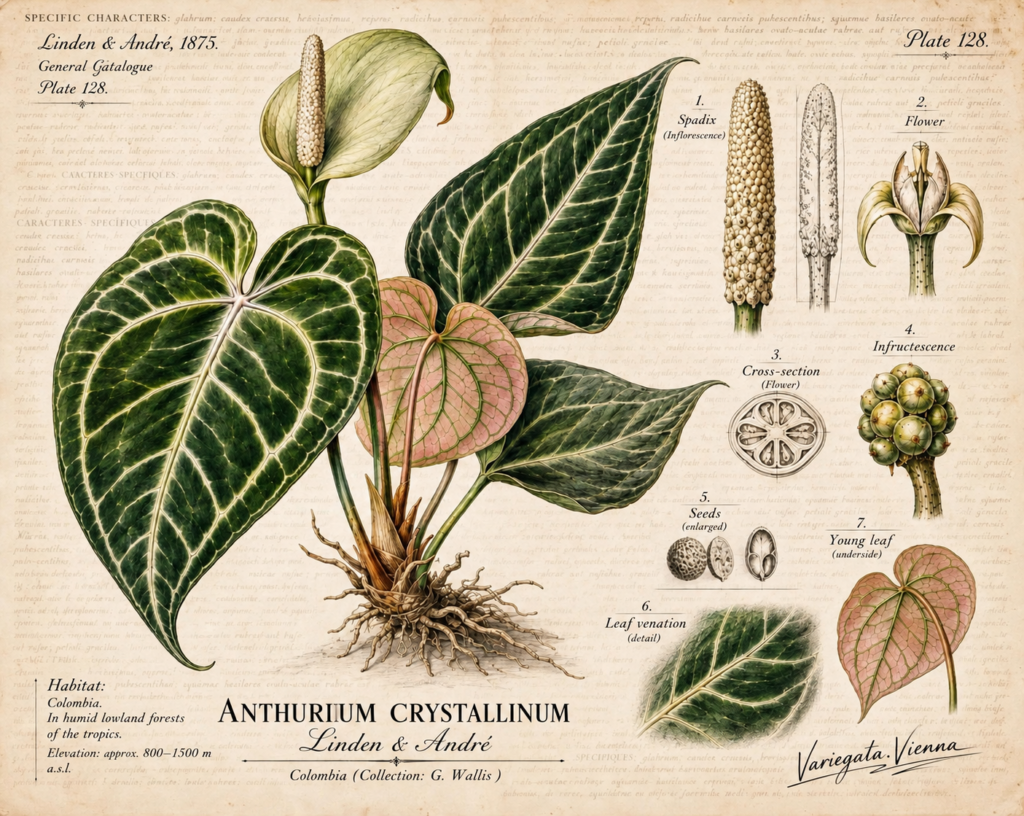
Anthurium crystallinum Linden & André
Scientific Name
Accepted Name: Anthurium crystallinum Linden & André
Authors: Jean Jules Linden & Édouard André
First publication (nomenclatural): Catalogue Général, no. 90, t. 128 (1873)
Historical plate: L’Illustration horticole, Tome XX, Pl. 106 (1873) — P. de Pannemaeker del. & lith.
Family: Araceae
Genus: Anthurium
Section: Cardiolonchium
Type: Wallis s.n., Colombia, K (K000434239)
Overview
Anthurium crystallinum Linden & André is one of the defining velvet-leaved Anthurium species of the nineteenth century. First published in 1873, it was described from a living plant collected in New Granada by Gustav Wallis in 1872 and cultivated in Jean Linden’s garden in Brussels.
The original diagnosis is particularly valuable because it explicitly records that the plant was described from a living specimen that was haud florentem — not flowering. The 1873 account therefore provides an exceptionally direct historical record of the vegetative characters that made the species remarkable.
This article deliberately separates three levels of evidence: what was documented in 1873, what is currently accepted from modern botanical sources, and what remains historically possible but unproven.
Quick Facts
Native range: Panama to Colombia
Colombian elevation data: 500–1000 m a.s.l.
Growth habit: Epiphytic subshrub
Biome: Wet tropical
Leaf: Evergreen, cordate, velvety, dark green
Distinctive features: Crystalline sheen, silvery venation, purple-violet young leaves and a purple-lined margin
Inflorescence: In the original description, the plant was not observed flowering
History
Wallis — 1872
The historical trail begins with Gustav Wallis, whose collection from New Granada in 1872 brought the plant into European cultivation. A specimen preserved at Kew, Wallis s.n. (K000434239), is designated as type material.
Linden’s garden in Brussels — 1873
The living plant was cultivated in Jean Linden’s garden in Brussels, where Édouard André prepared the original description. The nomenclatural publication appeared in Catalogue Général, no. 90, t. 128, in 1873.
The diagnosis was explicitly made from a living, non-flowering plant. A parallel historical illustration appeared in L’Illustration horticole, Tome XX, Pl. 106 (1873), prepared by P. de Pannemaeker.
Ghent — 1873
In the horticultural world of 1873, Anthurium crystallinum was presented as a spectacular foliage plant. The historical account places it among the plants that created a sensation at Ghent and compares its ornamental effect with the already celebrated Anthurium magnificum.
The historical description repeatedly emphasizes the crystalline appearance of the upper leaf surface. This characteristic makes the meaning of the specific epithet crystallinum immediately evocative, without requiring the unsupported claim that the source explicitly states this was the reason for the name.
1873–1887 — What remains undocumented
The surviving evidence does not justify a blanket claim that the species was cultivated during this entire period by Kew, Veitch or Schönbrunn. Such statements should only be added where a contemporary primary source can be identified.
Vienna — 1887
By 1887, Anthurium crystallinum appears in the documented Viennese history of Anthurium cultivation. The Wiener Illustrirte Garten-Zeitung and the contemporary account Über Befruchtung und Anzucht der Anthurien document the use of A. crystallinum pollen in artificial pollination experiments.
This provides a firm historical connection between A. crystallinum and the experimental cultivation of Anthurium in Vienna. A specific historical cross of A. crystallinum × A. magnificum, however, remains unproven and should not be presented as established fact.
Botanical Description
Original diagnosis, 1873:
glabrum; caudex crassus, brevissimus, repens, radicibus carnosis pubescentibus; squamae basilares ovato-acutae rubrae aut rufae; petioli graciles ad basim rubescentem incrassati breviter vaginantes mox teretes olivacei lenticulis albis subepidermodeis conspersi, apice geniculo erecto brevi cylindrico subcurvato; lamina ampla, A. magnificum magnitudine formaque referens, ovato-cordata abrupte acuminata mucronata inter nervos subgibbosa, sinu modico, auriculis rotundatis equitantibus, pagina superior intense viridis nitore crystallina praecipue ad nervorum conjunctionem micantissima, in costa nervisque praecipuis arcuatis vitta argentea regulariter depicta, margine lineato-purpurata; pagina inferior pallide viridis; folia juniora purpureo-violacea; flores ….
Historical translation:
Glabrous; stem thick, very short and creeping, with fleshy, pubescent roots; basal scales ovate-pointed, red or reddish; petioles slender, thickened at the reddish base, shortly sheathing, then cylindrical and olive-green, covered with white subepidermal lenticels, terminating in a short, erect, cylindrical and slightly curved geniculum; blade large, resembling A. magnificum in size and form, ovate-cordate, abruptly acuminate and mucronate, slightly gibbous between the veins, with a moderate sinus and rounded, overlapping auricles; upper surface intensely green with a crystalline sheen, especially brilliant at the junctions of the veins, regularly marked along the midrib and principal arcuate veins with a silver band; margin lined purple; lower surface pale green; young leaves purple-violet.
The diagnosis continues by distinguishing the species from A. magnificum by its cylindrical, non-four-winged petioles, its rounded rather than winged geniculum, non-erect ribs, moderate sinus and snow-white transverse and radiating bands.
The historical diagnosis is especially important because it ends with the explicit statement that the plant was described from a living specimen that was not flowering: Ad vivum descripsi (haud florentem) in horto Lindeniano.
Comparison with Anthurium magnificum
| Character | A. magnificum | A. crystallinum |
|---|---|---|
| Petiole | Four-winged | Cylindrical |
| Geniculum | Twisted / winged | Cylindrical, slightly curved |
| Midrib | More lamellate | Less prominent |
| Silver banding | Pale green | Snow-white / crystalline |
| Sinus | Deep | Moderate |
| Auricles | More separated | Rounded and overlapping |
| Transverse / radiating bands | Less strongly contrasted | Snow-white and strongly contrasted |
Cultivation
Anthurium crystallinum is best cultivated as an epiphytic aroid with excellent root aeration, stable moisture and high atmospheric humidity.
Light: approximately 10,000–20,000 lux, corresponding roughly to 50–150 PPFD depending on conditions. Avoid intense direct midday sun.
Humidity: minimum around 60%; approximately 70–85% is generally suitable for vigorous growth.
Substrate: airy, open and fast-draining, with substantial structure around the roots.
Temperature: approximately 18–27 °C; prolonged night temperatures below 16 °C should be avoided.
Watering: keep the root zone evenly moist, but never stagnant or permanently saturated; strong ventilation is important.
Vienna 1887
The documented Viennese record from 1887 is particularly significant because it places A. crystallinum in the context of deliberate Anthurium breeding and pollination experiments. Contemporary publications record the use of its pollen in artificial pollination.
This is evidence for the species’ participation in historical horticultural experimentation in Vienna. It is not, however, evidence that a particular famous hybrid originated from A. crystallinum. Any specific parentage must be demonstrated independently from historical documentation.
Taxonomy
Accepted name: Anthurium crystallinum Linden & André
Family: Araceae
Genus: Anthurium
Section: Cardiolonchium
Type: Wallis s.n., Colombia, K (K000434239)
Kew’s Plants of the World Online currently accepts Anthurium crystallinum Linden & André. Its current native range is given as Panama to Colombia. Kew also lists the heterotypic synonyms Anthurium crystallinum f. peltifolium Engl. and Anthurium killipianum L.Uribe.
References
Linden, J. & André, É. (1873). Catalogue Général, no. 90, t. 128.
André, É. (1873). L’Illustration horticole, Tome XX, Pl. 106. P. de Pannemaeker, del. & lith.
Wiener Illustrirte Garten-Zeitung (1887).
Über Befruchtung und Anzucht der Anthurien (1887).
Royal Botanic Gardens, Kew. Plants of the World Online. Anthurium crystallinum Linden & André.
International Aroid Society. Anthurium crystallinum.
World Flora Online. Anthurium crystallinum Linden & André.
© 2026 Variegata.Vienna
Rare & Variegated Aroids from Vienna