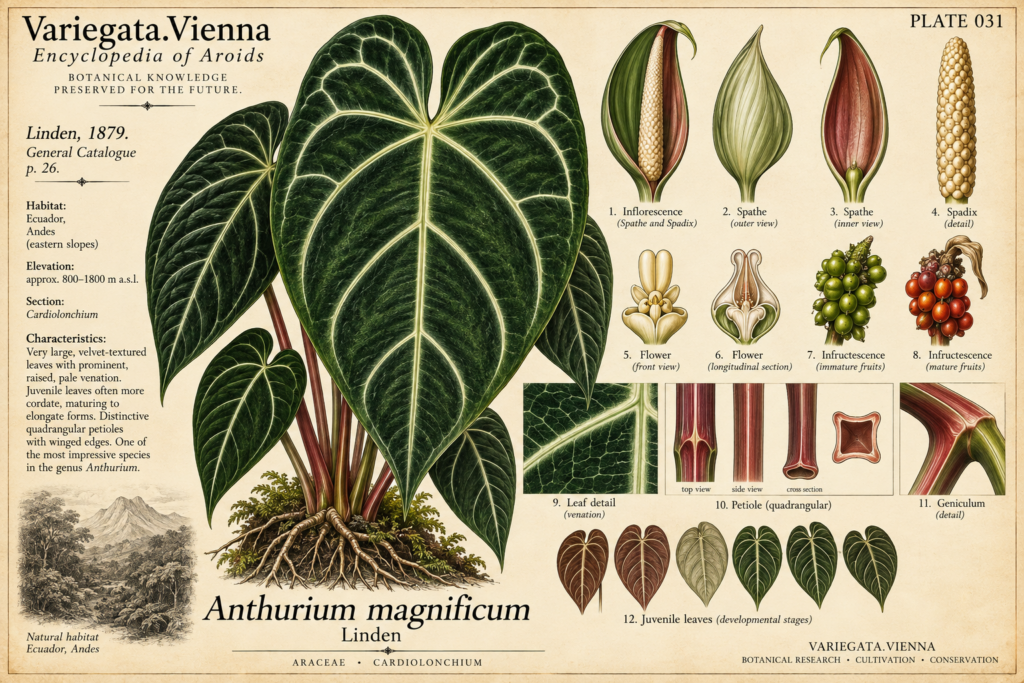
Anthurium magnificum Linden
Scientific Name
Accepted Name: Anthurium magnificum Linden
Author: Jean Jules Linden
First Published: La Belgique Horticole, Volume XV, page 98 (1865)
Family: Araceae
Genus: Anthurium
Section: Cardiolonchium
Overview
Anthurium magnificum is one of the most historically significant velvet-leaved species within the genus Anthurium. From the moment of its introduction in 1865, it was regarded as an extraordinary ornamental plant and quickly became one of the most admired foliage species of its time.
The species is distinguished by its large, heart-shaped, leathery leaves, a deep velvety green surface, and striking silvery veins. In the original protologue, Jean Jules Linden also described the remarkable colour transformation of emerging leaves, a characteristic that continues to fascinate collectors today.
Beyond its ornamental beauty, Anthurium magnificum occupies an important place in botanical history. It was among the earliest large velvet Anthuriums introduced to European horticulture and helped establish the international appreciation of tropical foliage plants.
Quick Facts
Native Range: Colombia
Distribution: Eastern slopes of the Colombian Andes (Cundinamarca)
Growth Habit: Primarily terrestrial
Leaf Type: Large, leathery, cordate leaves
Distinctive Features
- Quadrangular, winged petioles
- Deep velvety green foliage
- Prominent silvery leaf veins
- Remarkable colour change of emerging leaves
- One of the most historically important Anthurium species
Variegata.Vienna Rating
🌍 Rarity: ★★★☆☆
💎 Collector Value: ★★★★☆
🎨 Ornamental Value: ★★★★★
🌿 Cultivation Difficulty: ★★★☆☆
🌱 Beginner Friendly: ★★★☆☆
📈 Growth Rate: ★★★☆☆
History
The story of Anthurium magnificum begins in the tropical montane forests of Colombia.
The species was discovered by the plant collector Braam, who found it on the eastern slopes of the Cordillera in the Province of Cundinamarca, then part of the United States of Colombia. Living plants were subsequently introduced to Europe, where Jean Jules Linden formally described the species in 1865 in La Belgique Horticole.
From the very beginning, Linden considered Anthurium magnificum to be an exceptional ornamental plant. In the original protologue, he predicted that its introduction would create as much—if not even greater—excitement in horticultural circles as Cyanophyllum magnificum and Begonia rex, two of the most celebrated ornamental foliage plants of the nineteenth century.
This comparison illustrates the remarkable importance that Linden attributed to the species at the time of its introduction.
An additional historical detail appears one year later in the protologue of Anthurium regale. There, Linden noted that Anthurium magnificum had already entered commercial cultivation during the spring of 1865 and had briefly been distributed in England under the incorrect name Anthurium cordifolium. He explicitly clarified that this name had already been assigned to a different species described by Karl Sigismund Kunth.
More than 160 years after its scientific description, Anthurium magnificum remains one of the defining species of the genus Anthurium and continues to be regarded as a classic among the velvet-leaved species.
Habitat
Anthurium magnificum is native to Colombia, where it inhabits humid montane forests along the eastern slopes of the Andes.
Its natural habitat is characterised by:
- High humidity throughout the year
- Mild temperatures with little seasonal variation
- Bright, filtered light beneath the forest canopy
- Organic, humus-rich forest soils
- Consistently moist growing conditions
Cultivation
☀️ Light
In its natural habitat, Anthurium magnificum grows beneath the canopy of tall trees, receiving bright but filtered light throughout the day.
Recommended Conditions
- Very bright location
- Avoid prolonged direct midday sun
- Gentle morning or late afternoon sunlight is generally well tolerated
- High-quality LED grow lights produce excellent results
Optimal Lux, PPFD, and DLI values are currently being further investigated.
💧 Humidity
High humidity promotes the development of large, healthy foliage.
Recommended Conditions
- Minimum: approximately 60% RH
- Optimal: 70–85% RH
- Good air circulation is strongly recommended
🌱 Substrate
As a primarily terrestrial species, Anthurium magnificum performs best in coarse, well-aerated substrates that retain moisture while providing excellent drainage.
Suitable components include:
- Pine bark
- Perlite or pumice
- Coconut chips
- Small amounts of organic material
Waterlogged conditions should always be avoided.
🌡 Temperature
Ideal growing temperatures range between
18–26 °C (64–79 °F)
Short periods of cooler temperatures are generally tolerated, while prolonged exposure to cold should be avoided.
🌿 Growth Habit
As the plant matures, Anthurium magnificum develops increasingly robust petioles and large leathery leaves with striking venation.
In the original protologue, Jean Jules Linden described the characteristic colour transformation of newly emerging leaves, which gradually change from pale red to deep red before maturing through brown tones. Whether this remarkable colour change represents a shared characteristic of a larger number of species within section Cardiolonchium is currently the subject of ongoing research.
Taxonomy
Family: Araceae
Genus: Anthurium
Section: Cardiolonchium
Species: Anthurium magnificum Linden
Scientifically Supported Information
The information presented in this article is supported by multiple independent botanical sources, including:
- Original protologue (La Belgique Horticole, 1865)
- Royal Botanic Gardens, Kew – Plants of the World Online (POWO)
- World Checklist of Selected Plant Families
- Modern taxonomic literature on the genus Anthurium
- Historical botanical literature of the nineteenth century
References
- Linden, J. (1865). La Belgique Horticole, Volume XV, page 98.
- Royal Botanic Gardens, Kew – Plants of the World Online (POWO)
- World Checklist of Selected Plant Families
- Additional botanical literature and historical references
Editorial Note
This species profile is based on the current state of botanical knowledge and carefully documented cultivation experience. Historical information has been verified against primary sources whenever possible. The article is continuously reviewed and updated as new scientific publications and verified observations become available.